From SportVille to an Evergreen Game: How SuperCity Has Been Running for 15
What the report saysFeatured 25.08.2026 18:39 25.08.2026 18:39 Alexander Semenov Published by Alexander Semenov Tags:Playkot,SuperCityIn July 2026, SuperCity turned 15. Over that time, Playkot’s game evolved from a…
What the report says
Featured 25.08.2026 18:39 25.08.2026 18:39 Alexander Semenov Published by Alexander Semenov Tags:Playkot,SuperCityIn July 2026, SuperCity turned 15. Over that time, Playkot’s game evolved from a browser-based city-building project into one of the company’s longest-running products – and one of the longest-running titles in the genre overall – generating more than $100 million in revenue and reaching 40 million installs. The story of SuperCity is interesting not only because of the numbers. It is also the story of how the game repeatedly found itself close to a technological or product dead end and each time found a new form without destroying what players valued about it.Today, SuperCity is developed by an autonomous studio within Playkot.
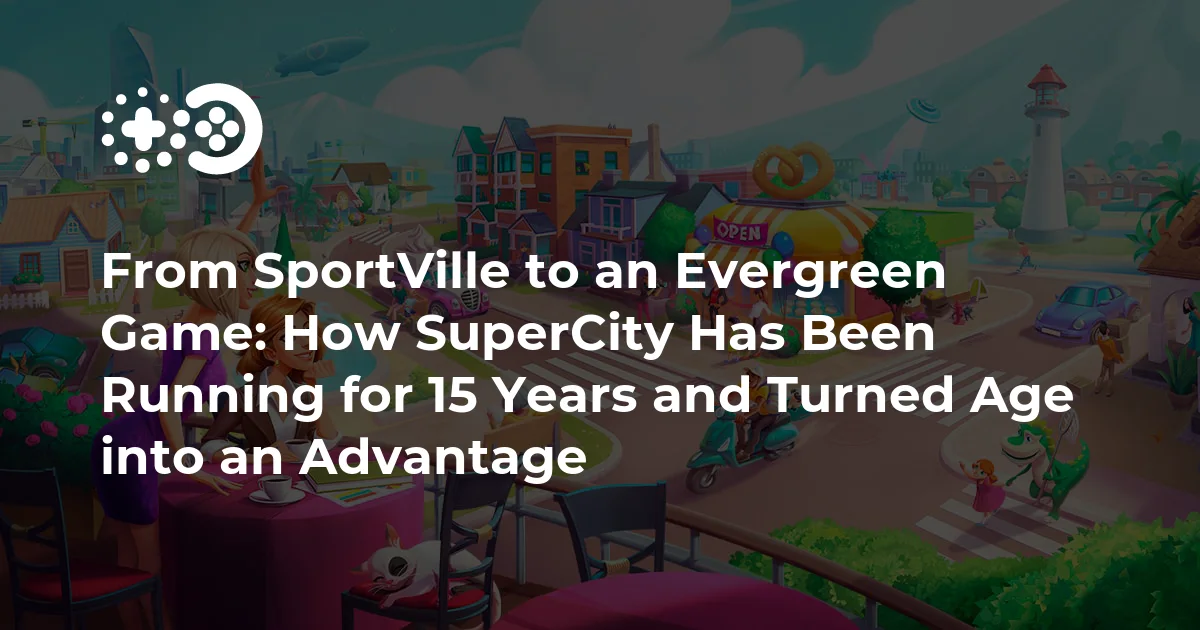
Its CEO, Denis Adlerberg, and the game’s Chief Product Officer, Lera Fedorova, say that the project’s main asset is not its age or even its accumulated content, but the trust of its audience. That same trust creates the game’s main constraint: a mature product cannot simply be rebuilt around the latest market trend. It has to evolve through small but continuous steps, preserving familiar rituals while giving players new reasons to return.A Game That Did Not Start with a CitySuperCity did not begin as SuperCity. The original concept was called SportVille, while its English version was named Fitness City.
According to the team, the idea came to Playkot founder Alexander Pavlov during a workout: to create a city entirely dedicated to sports, with stadiums, clubs and themed activities.No sooner said than done! Just a few months later, the new game was released. The first playtests showed that a sports theme alone was not enough. Players did not understand why they were expected to build only stadiums or why their options were limited to a single idea. The team quickly redirected the project toward a more universal city. Individual buildings, stadiums, resource loops and characters remained from the original concept, eventually evolving from sports archetypes into SuperCity’s first residents.Along with the new name came a more important decision: the emotional tone.

Key details
SuperCity was conceived as a kind world with no truly dark storylines, where difficulties ultimately end well. Aliens, yetis, dinosaurs or the Loch Ness Monster may appear in the game, but the player’s task is not to defeat them. It is to understand what happened and help them.This approach became SuperCity’s first major difference from the many social farming games and city-builders of the early 2010s. Much of the market was built around repetitive economic loops: produce a resource, transform it and invest it into the next upgrade. SuperCity made its core loop more meditative and added “super stories” – chains of quests centered on helping characters.
Players did not simply expand their cities; they turned potential “monsters” into neighbors.Early Growth and the Problem of SuccessThe launch on Facebook in 2014 marked the project’s international growth. SuperCity received industry recognition as one of the year’s best new social games, while its popularity led to advertising integrations with major brands, whose buildings became part of players’ cities.But scale quickly created a new problem. The audience consumed content faster than the small team could produce it. The developers had to establish regular delivery cycles, expand the team and gradually move toward what today would be described as a full LiveOps model.This model worked for several years, but by around 2017 the project faced two threats at once.
Players had learned the recurring mechanics, while the social games market was rapidly losing ground to mobile. At the same time, the end of Flash support was approaching – the technology on which the game had been built. For many browser-based projects, this became a point of closure.The team itself was not certain that SuperCity would survive the transition. However, instead of gradually winding the product down, Playkot continued to invest in it. The game migrated from Flash to HTML5, the team strengthened its analytics capabilities and began making more decisions based on data: examining what genuinely engaged players, developing parallel gameplay loops and investing not only in new offers, but also in new modes.This period is important for understanding everything that follows.
More from the announcement
SuperCity became an evergreen product not because it once discovered a flawless formula. On the contrary, the feeling that the game “would always be there” emerged only after several crises.